PrEP has been available for years, yet there are still many questions surrounding it: Is it only for younger people? Who pays for it? Do I have to go to a specific GP’s surgery? The answers depend very much on where you live. Here you’ll find the latest information as of September 2026 for Germany, Austria, Switzerland and the Netherlands – without any panic or finger-wagging.
What PrEP is
PrEP stands for pre-exposure prophylaxis. HIV-negative people take a medication used in HIV treatment – a tablet containing the active ingredients tenofovir and emtricitabine. If HIV enters the body, it cannot replicate, and infection is prevented. According to Deutscher Aidshilfe, when used correctly, PrEP offers protection against HIV that is just as effective as condoms.
You can either take it daily on a long-term basis or around the times when you are at risk of HIV. For the second option, Deutsche Aidshilfe recommends the following for sex between men: take two tablets at once at the earliest 24 hours and at the latest 2 hours beforehand, then one daily, and one tablet a day for two days following the last exposure. You should discuss which option suits you best at the clinic. You should not confuse PrEP with PEP: PEP is only taken after an exposure, as an emergency measure.
Who it is intended for
The German-Austrian PrEP guidelines recommend PrEP for people at increased risk of HIV. This includes, for example, men who have sex with men and who have had anal sex without a condom in the last three to six months or are likely to have it in the coming months, and men who have had a sexually transmitted infection in the last twelve months. Soa Aids Nederland sums it up well: the risk doesn’t depend on who you are, but on what you do during sex.
One important point to note here is that anyone living with HIV who is taking medication and has had an undetectable viral load for at least six months cannot pass on HIV through sex. This is known as n=n, ‘undetectable = untransmittable’, or U=U in English.
PrEP has no age limit
Many older men associate PrEP with twenty-somethings. However, the recommendations are based on risk, not on year of birth. Anyone who is dating again after a long-term relationship or simply getting to know new people is just as entitled to good advice as anyone else.
As the years go by, a few points become more important, and these should be discussed openly with your doctor:
Kidneys: PrEP reduces kidney function slightly. If kidney function is normal, there is no reason not to take it; however, if function is severely reduced – for example, due to diabetes – you should not start taking it. Once you stop taking it, kidney function usually recovers.
Other medicines: Anti-inflammatory drugs and painkillers can put a strain on the kidneys when taken alongside PrEP, so regular check-ups are particularly important. According to Deutsche Aidshilfe, PrEP is compatible with erectile dysfunction medication and antibiotics.
Be open: Tell your GP what else you’re taking, including herbal remedies. If you take protein or creatine powder, mention this as well, as it can affect the results of your kidney function tests.
Side effects, viewed objectively
Most people tolerate PrEP well. Some experience nausea, diarrhoea, headaches or stomach aches, tiredness or sleep disturbances at the start. These symptoms usually subside after a few weeks. Side effects affecting the kidneys or bones are rare. That is precisely why regular check-ups are carried out.
What PrEP cannot do
PrEP protects against HIV, but not against syphilis, gonorrhoea, chlamydia or hepatitis. That’s why regular testing is part of PrEP, so that any infection can be detected and treated early. Condoms further reduce the risk of other sexually transmitted infections. It’s up to you to decide what you do with this information.
The check-ups
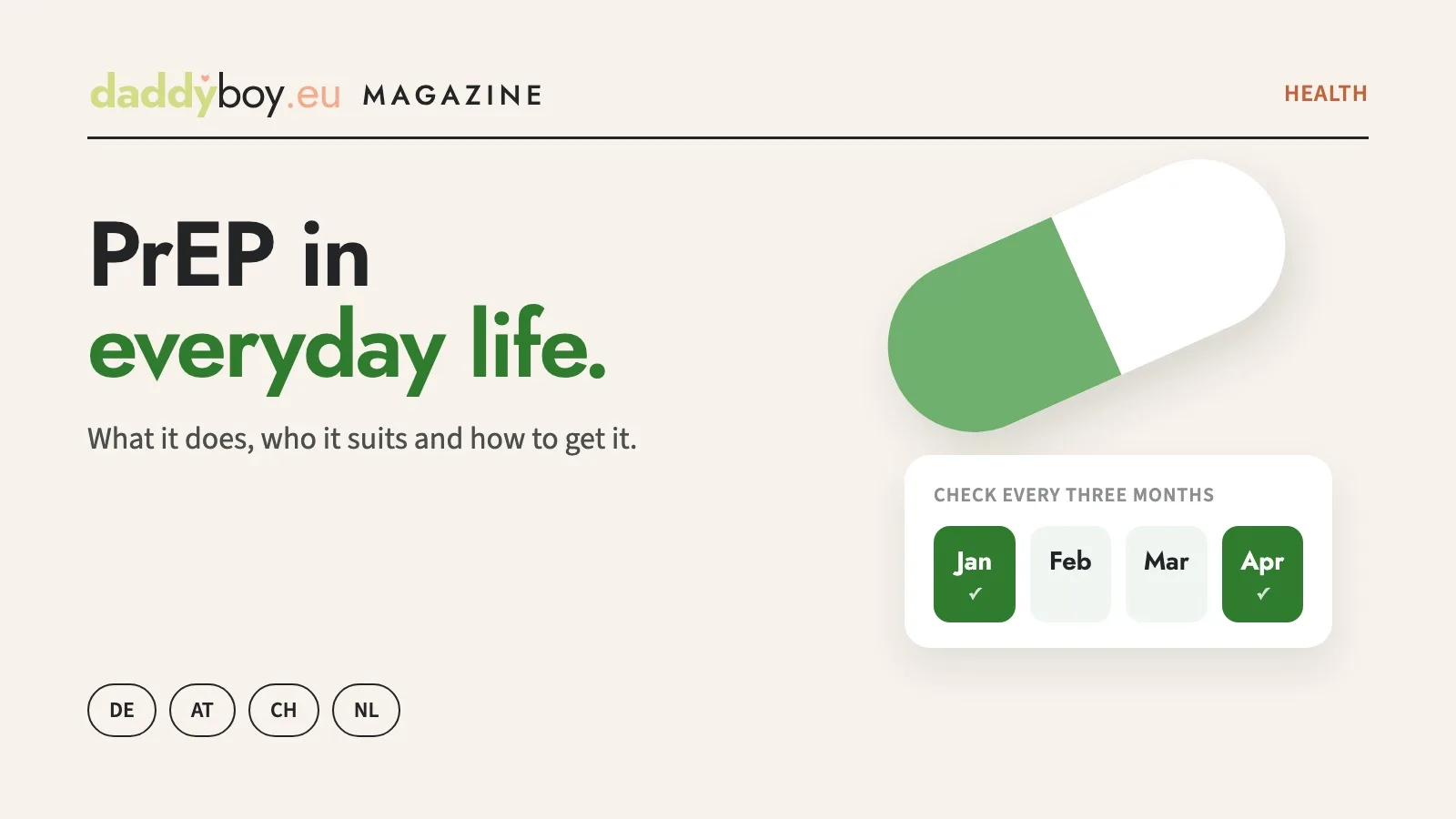
Before you start, an HIV test must confirm that you are HIV-negative, as an undiagnosed HIV infection cannot be treated with PrEP alone. You’ll also need a test for hepatitis B and a kidney function test. This is followed by regular check-ups for HIV and other sexually transmitted infections, usually at intervals of around three months. The Dutch RIVM recommends two to four times a year.
Germany
Since 1 September 2019, statutory health insurance schemes have been covering the costs of PrEP medication and associated tests for people aged 16 and over who are at increased risk of HIV. Only doctors who are knowledgeable about HIV or PrEP are authorised to prescribe PrEP on a statutory prescription. The process begins with a consultation, followed by a prescription for three months, with a new one issued at each check-up. You only pay the standard statutory co-payment, which, according to Deutsche Aidshilfe, is currently 10 euros for a three-month supply. From 2027, the statutory co-payments will increase by half, according to the Federal Ministry of Health.
Private health insurers have their own rules. With a private prescription, any doctor can prescribe PrEP for you; you will then pay for the medication and tests yourself. You can find medical practices using a search tool provided by the Federal Ministry of Health, the dagnä list or the prep.jetzt list – all of which are linked on the Deutsche Aidshilfe website. Many AIDS support organisations, checkpoints and public health authorities also offer tests for HIV and sexually transmitted infections, which can be taken anonymously. Some public health authorities have specific services for people without health insurance.
Austria
Since 1 April 2024, the health insurance providers ÖGK, SVS and BVAEB have been reimbursing up to 60 euros per monthly pack and 25 euros per quarter for the medical consultation, including for co-insured dependants. This means you pay at the pharmacy first and then submit the prescription and receipt, for example via MeineSV. According to Aids Hilfe Wien, people insured through the Krankenfürsorgeanstalten (KFA) are not yet covered by this scheme.
PrEP is available on prescription only, and according to the Ministry of Social Affairs, doctors specialising in HIV are required for assessment and support. The Austrian AIDS Society maintains a list of medical practices and pharmacies. Check-ups for HIV and other sexually transmitted infections take place every three months. According to Aids Hilfe Wien, funding is currently only guaranteed until the end of 2027; a permanent solution is still under political discussion. You can get advice from Aids Hilfe Wien and the other AIDS support organisations in Austria.
Switzerland
Since 1 July 2024, compulsory basic health insurance has covered PrEP – i.e. medication, medical services and laboratory tests – for certain groups. This includes men who have sex with men if at least one criterion applies, such as anal sex without a condom, a sexually transmitted infection or having undergone PEP in the last twelve months. A further requirement is that you have health insurance in Switzerland and that your GP’s practice is part of the SwissPrEPared network and is authorised to bill your health insurance provider. You do not need to be a member of SwissPrEPared yourself.
As with all healthcare services in Switzerland, you will pay the franchise and excess. According to Aids-Hilfe Schweiz, PrEP costs around 2,000 to 2,500 Swiss francs a year when taken daily, which is covered after your co-payment has been deducted. This arrangement is part of an evaluation: the Federal Department of Home Affairs will assess by December 2026 whether PrEP should remain permanently on the list of covered services. Aids-Hilfe Schweiz provides up-to-date information, including on choosing your franchise.
Netherlands
In the Netherlands, according to Soa Aids Nederland, health insurance does not yet cover the cost of PrEP tablets; you must purchase them yourself from a pharmacy. The price varies depending on the pharmacy; the RIVM quotes an average of around 30 euros for 30 tablets. Care provided by your GP is usually covered by insurance, although laboratory costs are deducted from your excess. Not every GP practice prescribes PrEP.
The alternative is the GGD: since 1 August 2024, PrEP care has been a permanent part of the services offered by sexual health centres. Counselling and testing for sexually transmitted infections are free there for people at increased risk of HIV, but you’ll still have to pay for the tablets yourself. As the budget is limited, there may be waiting lists. It’s best to enquire at your local GGD. All this is explained clearly by Soa Aids Nederland.
Talking about it
Whether you take PrEP, use condoms or both is your decision. Having an open conversation about it – ideally before the date – makes things much easier. And if you’re unsure about a situation, you can find confidential advice at AIDS help organisations and Checkpoints.
This article is not a substitute for medical advice.
On DaddyBoy
In the glossary, you’ll find brief explanations of ‘PrEP’ and ‘n=n’. Whether you include information about PrEP or testing under ‘Safer Sex’ in your profile is entirely up to you.