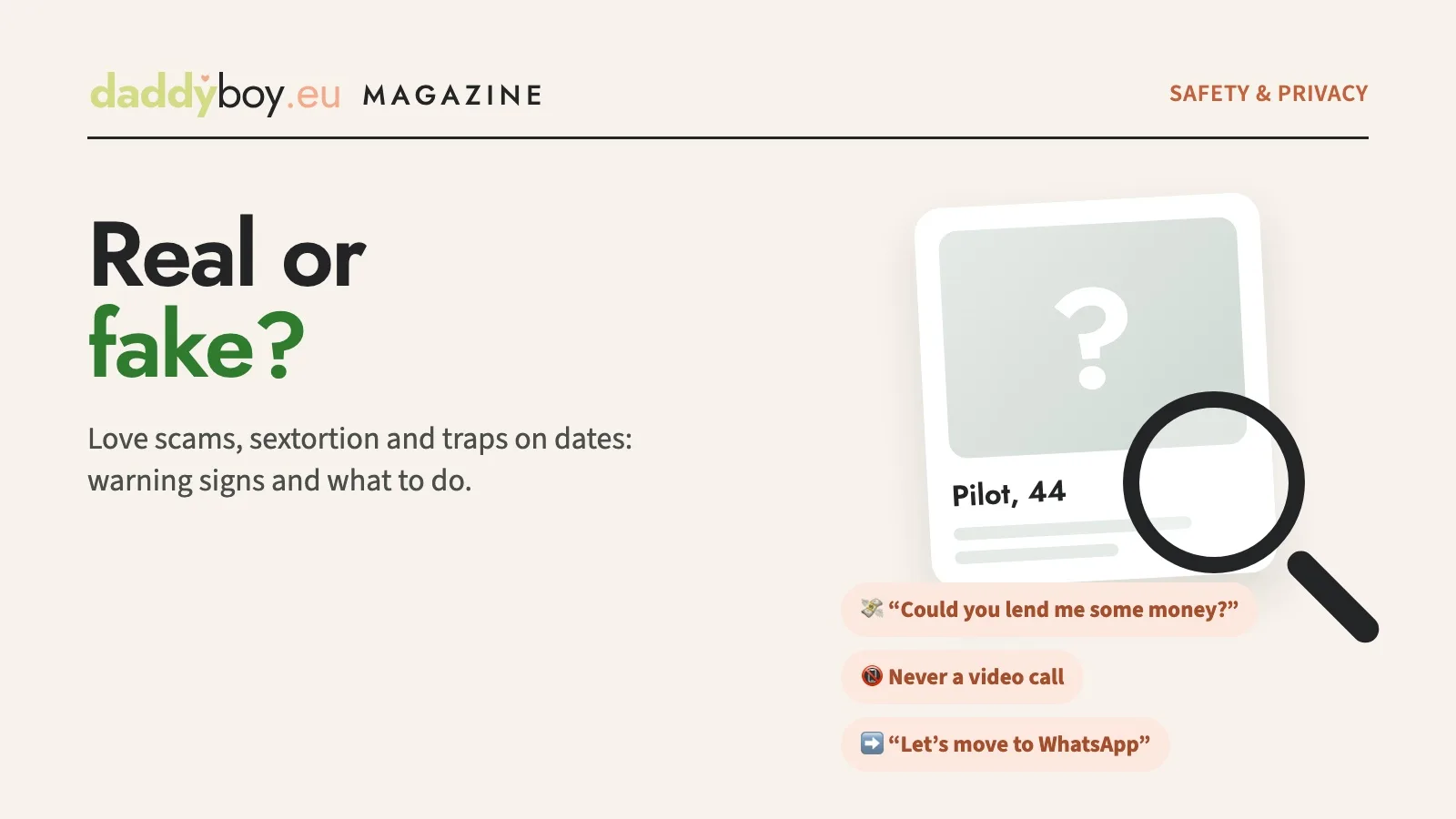
Most people you meet online are exactly who they appear to be. A small minority, however, are not: behind some profiles lie scammers who are after your money, intimate photos or, less commonly, a meeting that ends in a mugging. The police in Germany, Austria, Switzerland and the Netherlands have been warning about these same patterns for years. If you’re aware of them, you’ll spot them early on. This article isn’t intended to scare you, but to show you what to look out for and what to do if something does happen.
Love scam: when the love of your life suddenly needs money
In a love scam – also known as a romance scam – perpetrators build up a close relationship over weeks or months, usually via dating platforms or social media. At some point, they ask for money: for a flight ticket, an operation or an emergency abroad. A real-life meeting never takes place. The Austrian Federal Criminal Police Office explains that the perpetrators often pose as doctors, soldiers, pilots or oil rig workers – in other words, successful people who are currently stranded abroad.
Typical warning signs cited by the police and the Dutch Fraudehelpdesk include:
Very strong feelings develop very quickly. Compliments from day one, and talk of true love and shared plans soon follows.
Meet-ups keep falling through. Just before the meeting, an accident, illness or other emergency gets in the way.
No video calls. Your contact cannot or will not speak via video. The Fraudehelpdesk points out that this is changing due to artificial intelligence and that even video calls can be faked. A video call is therefore a good sign, but not proof.
A quick switch to another platform. He wants to continue chatting via WhatsApp or email soon, away from the platform where you met.
Money, gift vouchers, cryptocurrency. The police specifically mention gift vouchers and cryptocurrencies as payment methods demanded by fraudsters. The suggestion that he’s very successful at investing and that you should get involved is also a warning sign.
Secrecy. You’re told not to talk to anyone about him, supposedly because of a secret mission.
The Fraudehelpdesk identifies people over 40, widows and divorcees as preferred targets. As early as 2019, around 700 victims had reported losses totalling 12.5 million euros over the previous five years. For 2023, it cites an average loss of 30,000 euros per victim. There is no need to feel ashamed: the perpetrators work with great patience and method.
Reverse image search
Many fake profiles use photos found online: strikingly attractive, often looking as if they’ve come straight out of a catalogue. With a reverse image search, you can check whether a photo has already appeared elsewhere, for example under a different name. The Fraudehelpdesk recommends using Google Images, TinEye or Yandex for this. The Austrian Federal Criminal Police Office advises searching for the photo alongside the word ‘scammer’. Another clue can be clumsy sentences that sound as though they’ve been generated by a translation programme.
Sextortion: blackmail involving intimate images
The term ‘sextortion’ is a portmanteau of the English words ‘sex’ and ‘extortion’. The police describe the process as follows: a flirtation on a social network or dating platform, followed by a request for a video chat in which you are asked to undress. The perpetrators secretly record this and then demand money or further recordings. Otherwise, they threaten to send the images to family, friends or your employer, or to post them online. Organised gangs based abroad are often behind these crimes.
According to the Police Crime Prevention Service, the victims are often men. The Bavarian Ministry of Justice states that, both worldwide and in Bavaria, it is primarily young men who are blackmailed with nude photos or intimate videos. However, sextortion can affect anyone, regardless of age or gender, as the Austrian Federal Criminal Police Office emphasises.
If you find yourself in this situation, the police and specialist agencies in all four countries advise taking the same steps:
Do not pay. The blackmail usually does not stop after a payment; new demands will follow.
Stop responding. Cut off contact and block the blackmailer.
Save evidence. Take screenshots of the profile and chat history, messages, links, and the date and time before you block or delete anything.
Report it. To the platform where the contact originated, requesting that the content be deleted.
File a police report. Threatening to distribute nude images is a criminal offence. Swiss Crime Prevention points out that this is an offence prosecuted ex officio, meaning the police will investigate on their own initiative.
Talk about it. The Dutch website Veilig Internetten puts it plainly: it’s not your fault.
For images taken when you were an adult, there is also StopNCII.org, a free service provided by the UK Revenge Porn Helpline. The service creates a digital fingerprint from your image, whilst the image itself remains on your device. Participating platforms can then identify and remove copies.
A particular form of this is mass emails in which someone claims to have filmed you via your webcam. According to Swiss Crime Prevention, these are usually empty threats with no actual footage to back them up. The same rule applies here: do not pay.
When the threat is about being outed
For gay and bisexual men, there is often a second fear: that family, colleagues or neighbours will find out about their sexuality as a result of the blackmail. This is precisely what some perpetrators are counting on. In February 2024, the Schleswig-Holstein State Police issued a warning about robberies in which men were lured to remote locations – such as industrial estates, woodland or allotments – via a well-known dating platform for gay and bisexual men. There, the perpetrators would be waiting, attack their victims and steal money and valuables. Tim Jänke, the state police’s liaison officer for the LGBTIQ* community, said: “The perpetrators take advantage of the fact that their victims do not go to the police out of shame and fear of being outed.” He believes there are many unreported cases.
The most important thing to remember is this: you have nothing to be ashamed of, and the police are not there to out you. Feel free to ask for a contact person for queer people, as is available in Schleswig-Holstein.
The first meeting: stay safe rather than be suspicious
The Schleswig-Holstein State Police offer these tips for online dates, which are useful for any first date:
Don’t reveal too much about yourself at the start, such as your address, date of birth or financial details.
Meet in a busy, public place the first time, such as a café or restaurant.
Only meet up with someone whose full name you know.
Tell someone you trust when and where you’re meeting, and take your mobile phone with you.
This isn’t a sign of mistrust towards your date. Anyone who’s genuine won’t have a problem with starting with a coffee.
Where to get help
Anywhere: If you’re in immediate danger, dial the police emergency number; any police station will take a report.
Germany: WEISSER RING victim helpline, 116 006, free and anonymous, daily from 7 am to 10 pm. Information at polizei-beratung.de.
Austria: WEISSER RING victim helpline, 0800 112 112, free, anonymous and available 24 hours a day. Information from the Federal Criminal Police Office.
Switzerland: Report incidents and find information at cybercrimepolice.ch and via Swiss Crime Prevention.
Netherlands: Fraudehelpdesk, 088 786 73 72; in cases of sextortion, contact the police on 0900 8844 (ask for the Zeden department) and Veilig Internetten.
On DaddyBoy
The ‘Verified’ badge shows you that someone has verified their age using a form of ID. You can start a video call directly in the chat without revealing your number, and the ‘known in person’ badge shows you that at least two verified members know them in real life. If a profile or chat seems suspicious, you can report and block it straight away.