For the vast majority of gay men, travelling is just as relaxed as it is for everyone else. Nevertheless, it’s worth taking a quick look at the situation at your destination before every trip, because what’s taken for granted at home may be forbidden or at least risky elsewhere: holding hands on the beach, sharing a double bed in a hotel, or going on a date via an app. This article shows you where to find reliable information, what to look out for when dating whilst travelling and at the border, and who can help you if something does go wrong. Information current as of October 2026.
Where to find information before you travel
The first port of call is the travel advice issued by your own Foreign Office. This is updated regularly and is available for each country individually.
Germany: The Federal Foreign Office has specific advice for LGBTIQ travellers and recommends reading the travel and safety advice for your destination country beforehand.
Austria: The Ministry of Foreign Affairs (BMEIA) sets out a country’s regulations in the ‘Special Provisions’ section of its travel information. For Egypt, for example, it states that the offence of ‘indecent behaviour’ is sometimes interpreted very strictly and also includes homosexual acts.
Switzerland: The FDFA publishes travel advice and the contact details of diplomatic missions for each country under ‘Travelling Abroad’; there is also the Travel Admin travel app.
Netherlands: NederlandWereldwijd has a dedicated page entitled ‘Kan ik veilig reizen als lhbtiq+ persoon?’. It advises travellers to check the country’s travel advice, in particular to find out which laws and customs (‘wetten en gebruiken’) apply there.
For an overview, the Federal Foreign Office refers to the maps produced by ILGA, the international umbrella organisation for queer organisations. Worldwide, the ILGA World database provides information on a country-by-country basis. For Europe, there is the Rainbow Map by ILGA-Europe, which is published every May. The May 2026 edition assesses 49 countries according to 76 criteria: Spain leads the way with 89 per cent, whilst Russia and Azerbaijan bring up the rear with 2 per cent each, and Turkey with 5 per cent. The map assesses laws and policies, not everyday life.
Where sex between men is a criminal offence
According to ILGA World, as of June 2026, 65 UN member states criminalise consensual sexual acts between people of the same sex. In 7 of these, the law provides for the death penalty, whilst in a further 5 the legal situation is not entirely clear. In 2025, the number rose again for the first time in almost ten years: Burkina Faso introduced such a law for the first time, and in Trinidad and Tobago, decriminalisation was reversed. In June 2026, according to a report by the AP news agency, Niger was added to the list; its new Criminal Code provides for a prison sentence of five to ten years for such acts.
Other sources give slightly different figures: the German Federal Foreign Office cites more than seventy countries, whilst the Dutch government puts the figure at just over 60. The order of magnitude is the same, and the list fluctuates in both directions. For this reason, you will not find a list of countries here; instead, you should check the situation in your destination country again before every trip. The Federal Foreign Office also points out that same-sex relationships may be considered socially unacceptable even in places where there is no law prohibiting them, and that you are always subject to the laws of the country you are visiting, not those of your home country.
Dating whilst travelling
For many people, opening an app to see who’s nearby is part and parcel of travelling. In most countries, this isn’t a problem. In some, however, according to the Federal Foreign Office, the police monitor websites, dating apps or meeting places and specifically target LGBTIQ people via fake accounts. Human Rights Watch published a report on this in 2023 covering five countries in the Middle East and North Africa: for Egypt, Iraq and Jordan alone, it documents 20 cases in which security forces lured LGBT people into a trap using fake profiles on a dating app and on Facebook. In all the documented arrests, the victims’ mobile phones were searched, usually by force or under threat.
The second danger comes from common criminals. The Dutch government warns of fraudsters who create a profile, lure queer people to a location and then assault them there. What helps:
Read the country-specific advice beforehand. Where sex between men is a criminal offence, any date arranged via an app is a risk, even if the profile appears genuine.
Arrange your first meeting in a busy place. Not in a hotel room, not at a secluded address that they send you.
Let someone know. Tell someone you trust who you’re meeting and where.
Keep an eye on your drink. The Foreign Office advises against leaving food and drink unattended and expressly warns against knockout drops.
Be sparing with photos and personal details. Don’t share your face, hotel, room number or intimate photos until you know who you’re dealing with.
If in doubt, remain discreet. This is also the advice of the Federal Foreign Office: do not get drawn into discussions in the wrong place; simply do not react and leave the area if possible.
Your mobile phone at the border
Your mobile phone reveals a lot about you: apps, chats, photos. In some countries, border officials are permitted to inspect it. The US Customs and Border Protection (CBP), for example, states that its powers of inspection for all travellers also extend to electronic devices. If a device is locked and cannot be inspected, it may be confiscated, and in the case of foreign travellers, this may be taken into account when deciding on their admission. The figures are small: according to the CBP, in the US financial year 2025, the devices of 55,318 travellers were searched, out of more than 419 million travellers processed at border crossings. However, anyone staying in a country where homosexuality is a criminal offence should be aware of what is on their mobile phone. And the Dutch government points out that the authorities sometimes monitor what is shared on social media.
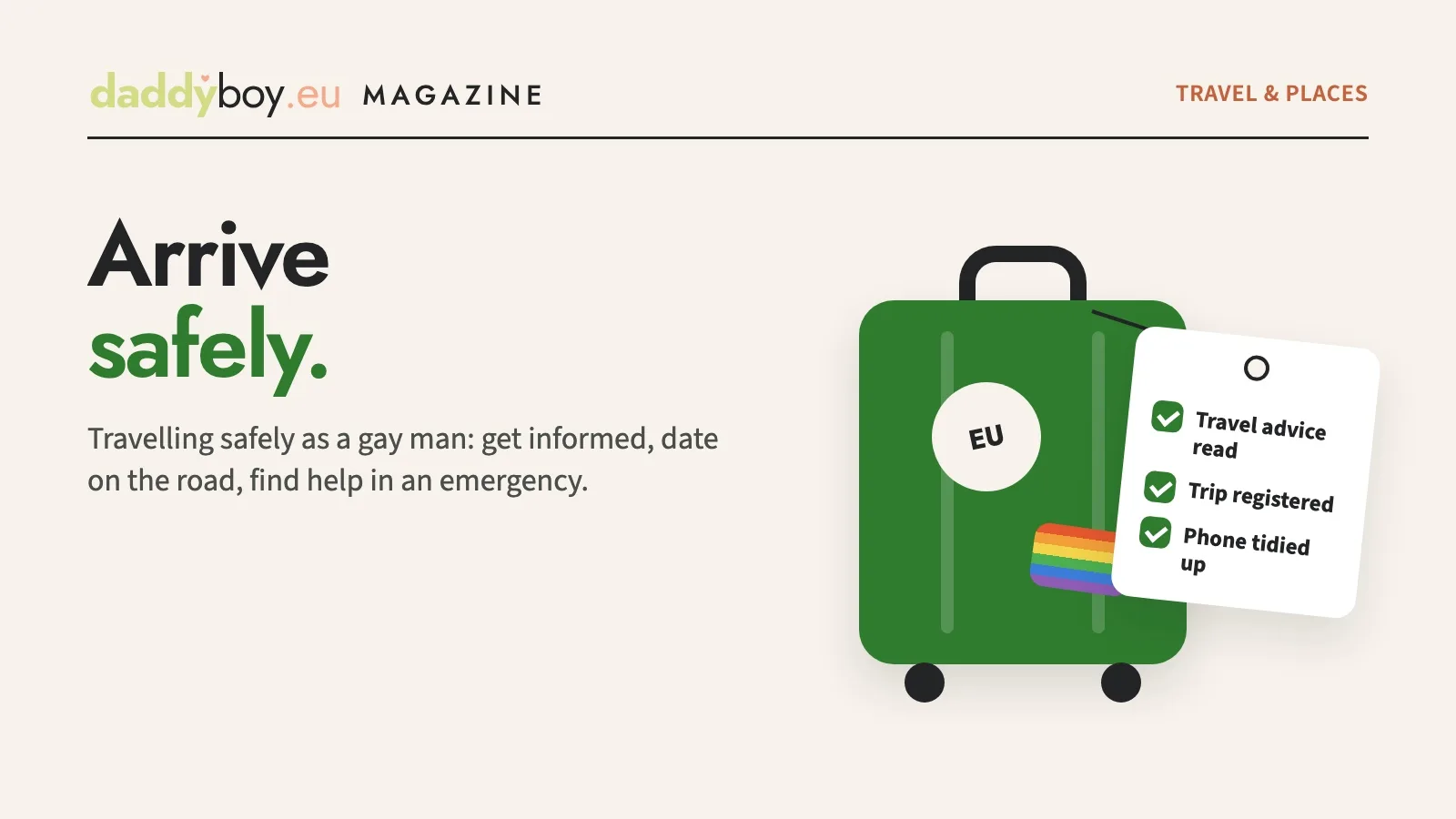
A few simple steps before you travel:
Log out of or delete dating apps before entering the country, and only reinstall them once you’re sure you want to use them at your destination.
Turn off message previews on the lock screen.
Back up intimate photos and chats and remove them from your device if you’re travelling to a country with criminal laws.
Think carefully about what you post whilst travelling and whether your location is visible in the post.
Travelling as a couple
Couples often face the question of booking a double room. The British Foreign Office points out that some hotels, particularly in rural areas, may refuse bookings from same-sex couples, and advises checking this in advance. A quick message to the hotel will save you an awkward situation at reception. Furthermore, as the Federal Foreign Office points out, same-sex marriage is not recognised in many countries. Rights that you have as a married couple at home – for example, in hospital – may not apply there.
If you’re a couple with a significant age difference, you may attract more attention whilst travelling than you do at home. Legally, the laws of the country you’re visiting always apply abroad, including age restrictions. If you’re unsure, check with the embassy or consulate of the country you’re visiting beforehand.
If you are taking medication such as PrEP or HIV treatment, check before travelling whether you are allowed to bring it into the country. According to the German Federal Foreign Office, some countries restrict entry for people living with HIV. The British Foreign Office advises checking in advance whether you’re allowed to take HIV medication into every country you’re visiting or travelling through.
If something happens
All four countries offer the option to register your trip in advance. This enables your Foreign Office or embassy to contact you in the event of a crisis. This is voluntary.
Germany: the ELEFAND crisis preparedness list (“Electronic Registration of Germans Abroad”) at krisenvorsorgeliste.diplo.de or, since June 2024, as an app. Travel details are automatically deleted after the specified duration of the trip.
Austria: the BMEIA’s free overseas registration service, available online or via the Auslandsservice app. For emergencies abroad: +43 1 90115 4411.
Switzerland: Travel Admin, available online or as an app. The FDFA helpline is available round the clock on +41 800 24-7-365 or +41 58 465 33 33. The FDFA warns that fraudsters have already spoofed these numbers to appear as the caller ID: do not disclose any information if you receive unexpected calls.
Netherlands: the Information Service of the Ministry of Foreign Affairs. The NederlandWereldwijd contact centre is available round the clock on +31 247 247 247, or via WhatsApp on +31 857 737 400.
What can the embassy do for you? According to the Federal Foreign Office, consular officials in the main tourist destinations can be reached outside office hours via an on-call service. If you are arrested, the embassy can, upon request, arrange for a lawyer and notify your next of kin. It cannot intervene in ongoing legal proceedings, and as a general rule it does not cover costs such as those for medical treatment. The Dutch government advises: if you are the victim of violence and are unsure whether you should go to the local police, contact the embassy or consulate first. If you report a crime, make sure you are given written confirmation. And before you travel, make a note of the local emergency number; within Europe, this is 112.
None of this is meant to put you off travelling. If you know what to expect at your destination, you’ll be able to get about more freely once you’re there.
On DaddyBoy
With Travel Mode, you can set your profile to your destination for a limited time; others will then see ‘visiting …’. Think carefully beforehand about whether you want to show this at your destination.