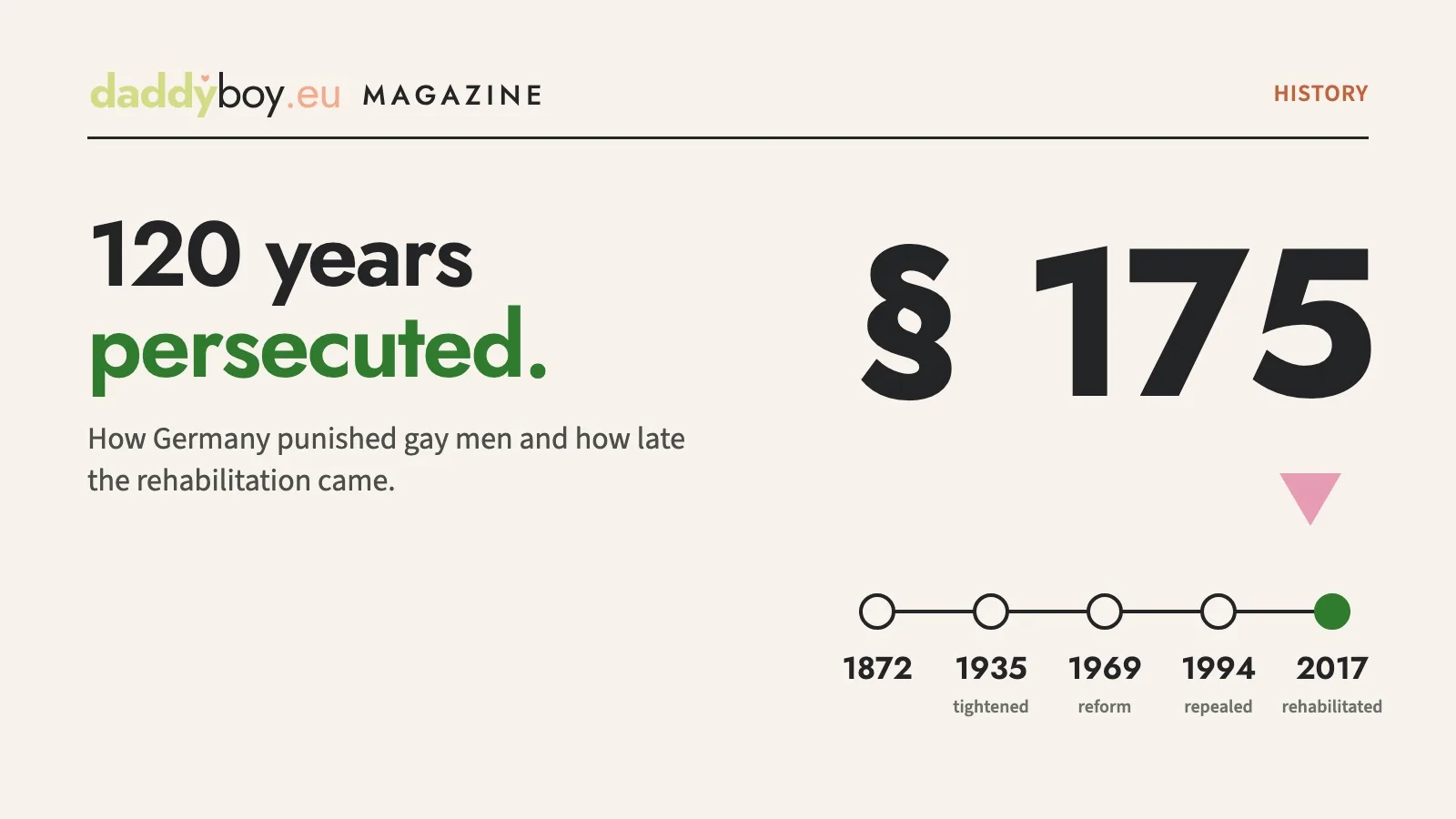
If a ‘daddy’ is in his mid-sixties today, he was a child when sex between men was still a criminal offence in the Federal Republic of Germany. And he was in his mid-thirties when the law was finally repealed. For many older gay men, Section 175 is not just a history lesson, but a part of their youth: the caution, the double life, the fear of being reported to the police. Many younger people now only know the number as a reference. This article explains what lies behind it.
1872: a legal provision for the whole Empire
On 1 January 1872, the Imperial Penal Code came into force. Its Section 175 made ‘unnatural sexual acts’ between men a criminal offence punishable by imprisonment. By 1918, almost 10,000 men had been convicted on this basis. Resistance emerged early on: in 1929, a Reichstag committee recommended that consensual acts between adult men be decriminalised. This was never implemented.
1935: the tightening of the law under National Socialism
The Nazis tightened the provisions of the section with effect from 1 September 1935. It was now no longer just a ‘sexual intercourse-like’ act that was punishable, but any act that a court classified as ‘sodomy’ between men. The new Section 175a provided for imprisonment for up to ten years in so-called serious cases.
The consequences were drastic. According to the Federal Agency for Civic Education, around 50,000 men were imprisoned under Section 175 during the Nazi era, and up to 15,000 were deported to concentration camps; other estimates put the figure at between 5,000 and 6,000. Many of them did not survive the camps. In the camps, they were forced to wear a pink triangle on their prison uniforms. Around 700 men were sent to Buchenwald and Mittelbau-Dora alone on the grounds of being homosexual. They were often forced to perform hard labour in the quarries as part of penal companies.
1945: liberated, but not free
The end of the war brought no justice for these men. The Allied Control Council repealed some Nazi provisions, but Section 175, as amended in 1935, remained in force. For decades, those who had survived whilst wearing the pink triangle were not recognised as victims of National Socialism.
In the Federal Republic, the section remained in force unchanged. In 1957, the Federal Constitutional Court expressly upheld the Nazi version, ruling that it was not of a Nazi nature and was compatible with the Basic Law. Between 1950 and 1965 alone, there were around 45,000 convictions in West Germany. This meant lost jobs, imprisonment, broken families, and, for many who were never charged, a life lived in constant fear.
The approach in the GDR
The GDR took a different path. In 1950, it reverted to the pre-1935 version, but continued to apply Section 175a; from 1957 onwards, consensual acts between adults were, in practice, no longer prosecuted. With the new Criminal Code of 1968, Section 175 was repealed. Section 151 remained, a special provision covering same-sex contact with young people, which was not repealed until 1988 (coming into force in July 1989).
1969 and 1973: Reforms in stages
In the West, the first reform came in 1969: sex between men over the age of 21 was now decriminalised. In 1973, the age limit was lowered to 18. A special provision thus remained in place, as different age limits applied to heterosexual relations. Prosecutions continued: as late as 1990, 96 men were convicted under this section in the former Federal Republic of Germany alone, and ten were in prison as a result. Anyone who was young during those years learnt early on what was best kept secret: not at work, often not within the family, and sometimes not even to friends.
1994: the end
It was not until reunification that the provision was abolished. With effect from 11 June 1994, Section 175 was repealed without replacement; since then, a uniform system of youth protection has applied, regardless of whether it concerns men, women or both. In total, around 140,000 men were convicted under Section 175 in its various forms.
The belated rehabilitation
The Bundestag overturned the Nazi-era convictions in 2002. For men who had been convicted after 1945, it took a further 15 years. On 22 June 2017, the Bundestag unanimously passed the Act on the Criminal Rehabilitation of Persons Convicted after 8 May 1945 for Consensual Homosexual Acts, known as the StrRehaHomG for short. It came into force on 22 July 2017. The Federal Government justified the law on the grounds that the criminal prohibition was “particularly contrary to fundamental rights according to today’s understanding”. Judgements from the Federal Republic of Germany and the GDR have since been deemed null and void, with the exception of cases involving parties under the age of 16 and acts that were also criminal offences among heterosexuals, such as those involving violence or the exploitation of a dependent position.
The compensation is modest:
3,000 euros per overturned judgement,
1,500 euros for each year or part thereof spent in custody,
and, following a directive of 13 March 2019, an additional 500 euros for each pre-trial investigation that did not result in a conviction, 1,500 euros for each year or part thereof spent in pre-trial detention, and a one-off payment of 1,500 euros in the event of exceptional professional, financial or health-related disadvantages.
The compensation is tax-free and is not counted towards social security benefits. The entitlement is strictly personal: heirs cannot claim it.
How many people have received it?
This illustrates just how late the rehabilitation came. The Federal Ministry of Justice estimates that between 1945 and 1994 there were around 69,000 convictions under Sections 175, 175a and GDR Section 151. By mid-July 2022 – the latest figures published – 335 people had applied for compensation; 259 received it, totalling around 885,500 euros. Many of those affected had already passed away by then. Others did not want to reopen the old case file; this, too, is a consequence of decades of shame.
Applications are accepted by the Federal Office of Justice in Bonn; they are informal and free of charge. You must enclose either the quashed judgement or a certificate of rehabilitation issued by the public prosecutor’s office. Anyone who no longer has these documents need not give up: the certificate can be applied for there. The deadline is 21 July 2027. If you know someone who was affected, letting them know about this could make a big difference.
Austria and the Netherlands
Austria did not lift the total ban under Section 129(1)(b) of the old Criminal Code until 1971, but at the same time introduced four new special provisions against same-sex contact. The last of these, Section 209, was struck down by the Constitutional Court in 2002 as unconstitutional. Since 1 February 2024, a law on rehabilitation and compensation has also been in force there, with the same amounts as in Germany: 3,000 euros per conviction, 1,500 euros per year spent in custody, 500 euros per pre-trial investigation and a one-off payment of 1,500 euros in cases of particular hardship. The Regional Court which originally heard the case at first instance, or within whose jurisdiction the court at the time was situated, is responsible. Applications may be submitted until the end of 2033.
The Netherlands had already decriminalised sex between men in 1811 under the Code Pénal, but in practice it was still prosecuted, for example through provisions against ‘fornication’. In 1911, Section 248bis was introduced: the age of consent for same-sex relations was set at 21, whilst for heterosexual relations it was 16. Thousands, predominantly men, were subsequently convicted. The section was repealed in 1971.
Why this matters today
The laws may be gone, but their traces remain. Some men have spent half their lives learning to make themselves invisible, and they do not simply shed that habit just because a law has changed. Between a ‘daddy’ and a ‘boy’, there are often not just decades, but two different legal eras. One generation experienced a time when love could be a criminal offence; the other has known nothing but a time when it is permitted. Both are part of the same story. Those who know this story understand better why some older people remain cautious to this day, and why what is taken for granted today had to be fought for.
On DaddyBoy
Stories spanning the generations make for good conversation: feel free to ask what it was like back then, or share your own experiences.